Honoring the Legacy of Rev. Martin Luther King, Jr.
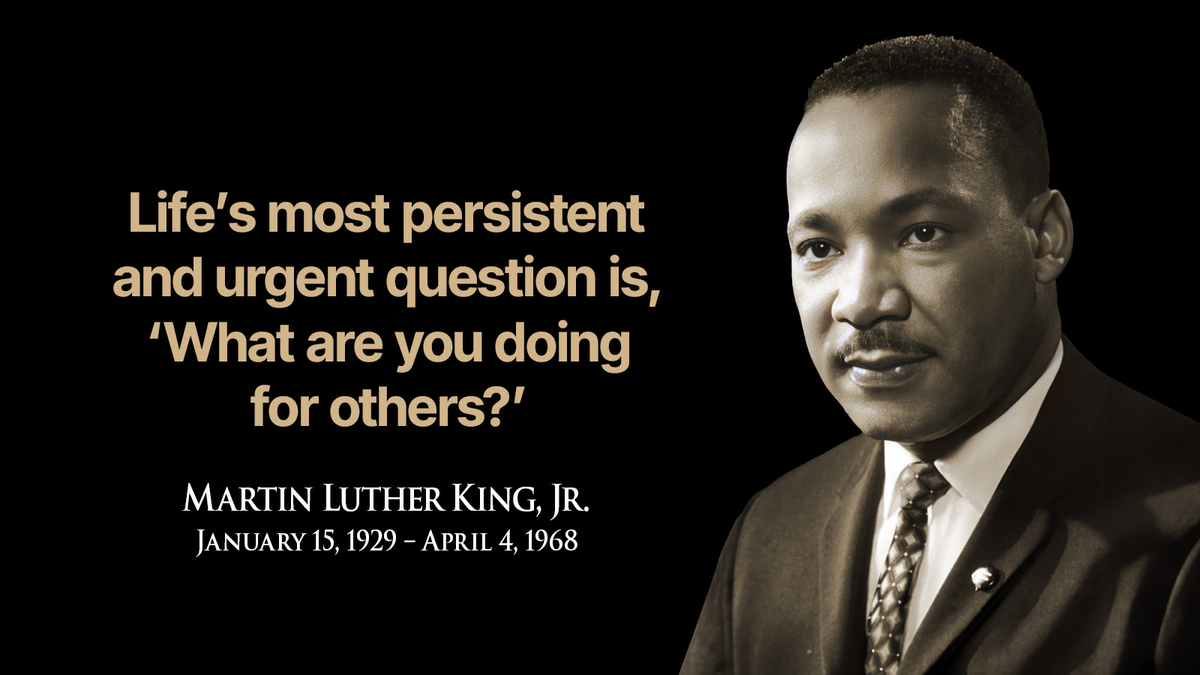
Let us remember why we honor the legacy of Dr. King today. Martin Luther King, Jr. was assassinated on April 4, 1968. The push to enact legislation to recognize this day as a federal holiday began just days after the assassination of Dr. King, in April 1968. It took another 15 years for it to be approved and another 17 years for it to be recognized in all 50 states.
I will assume that most of us are familiar with and have heard “I have a dream.” Perhaps some of us have heard or read “Letter from a Birmingham Jail.” The words in this letter from April 1963 speak to the heart of the fight for civil rights and the works of Dr. King, John Lewis and so many others who have fought and continue to fight the systematic suppression of people of color in our country.
In 1963, protestors were speaking out against desegregation in Birmingham, Alabama. During Holy Week, the Southern Christian Leadership Conference was invited to and did engage in protests, marches and sit-ins. The Commissioner of Public Safety in Birmingham ordered the demonstrators to cease their actions. In an act of civil disobedience, Dr. King and others refused to comply with the orders. He was arrested and held in the Birmingham City Jail. He had no bed to sleep on but he did have scraps of paper to record his thoughts. During the week, members of the moderate Christian clergy (aka – moderately liberal white clergy) issued critical statements toward the decision of the demonstrators to engage in such disobedience. With those scraps of paper, Rev. Martin Luther King, Jr. was able to express the rationale of how these actions were not only justified, but the right thing to do.
We encourage you to read the letter in its entirety. It is not long, only six pages. Perhaps, as you read it, you can consider how the words speak to you today. Can you identify something in your community where you may have felt the same way as those protestors in 1963? Maybe you have found yourself expressing the opinions of the moderately liberal clergy? You can find the entire letter here. Two powerful excerpts from this letter are as follows:
You may well ask, “Why direct action? Why sit-ins, marches, etc.? Isn’t negotiation a better path?” You are exactly right in your call for negotiation. Indeed, this is the purpose of direct action. Nonviolent direct action seeks to create such a crisis and establish such creative tension that a community that has constantly refused to negotiate is forced to confront the issue. My friends, I must say to you that we have not made a single gain in civil rights without legal and nonviolent pressure. History is the long and tragic story of the fact that privileged groups seldom give up their privileges voluntarily. Individuals may see the moral light and give up their unjust posture; but as Reinhold Niebuhr has reminded us, groups are more immoral than individuals. We know through painful experience that freedom is never voluntarily given by the oppressor; it must be demanded by the oppressed. Frankly I have never yet engaged in a direct action movement that was “well timed,” according to the timetable of those who have not suffered unduly from the disease of segregation. For years now I have heard the word “Wait!” It rings in the ear of every Negro with a piercing familiarity. This “wait” has almost always meant “never.” It has been a tranquilizing Thalidomide, relieving the emotional stress for a moment, only to give birth to an ill-formed infant of frustration. We must come to see with the distinguished jurist of yesterday that “justice too long delayed is justice denied.” We have waited for more than 340 years for our constitutional and God-given rights. The nations of Asia and Africa are moving with jetlike speed toward the goal of political independence, and we still creep at horse and buggy pace toward the gaining of a cup of coffee at a lunch counter.
And later:
I must make two honest confessions to you, my Christian and Jewish brothers. First, I must confess that over the last few years I have been gravely disappointed with the white moderate. I have almost reached the regrettable conclusion that the Negro’s great stumbling block in the stride toward freedom is not the White citizens’ “Councilor” or the Ku Klux Klanner, but the white moderate who is more devoted to “order” than to justice; who prefers a negative peace which is the absence of tension to a positive peace which is the presence of justice; who constantly says “I agree with you in the goal you seek, but I can’t agree with your methods of direst action” who paternistically feels that he can set the timetable for another man’s freedom; who lives by the myth of time and who constantly advises the Negro to wait until a “more convenient season.” Shallow understanding from people of good will is more frustrating than absolute misunderstanding from people of ill will. Lukewarm acceptance is much more bewildering than outright rejection.
Later on in 1963, the March on Washington happened and “I Have a Dream” was heard around the world. The Civil Rights Act passed the following year. How impactful the action of these courageous leaders were!
As an adult, I have come to realize that my experience is very different than the experience of people in the BIPOC community. As an adult, I have been able to get a much different education than I received in formal school settings. This education came in the form of awkward conversations, trusted cohorts pointing out my ignorance and the grace of mentors. Through hearing their experiences, my eyes have been opened to the systemic suppression of people of color. I began to see the fight that people who look different than me are and have been fighting. As people of privilege, we must come to terms with ourselves. There is real danger in assuming the needs of an individual or the impulse to impart our “wisdom” without actually listening to and walking along side that person. It is very easy to place judgement. It is much more difficult to acknowledge that what we may think we know or the actions we have taken are harmful.
These words are not meant to shame. It is a plea to all of us to ask ourselves the hard questions. How have I done the work to be in community with my neighbors? What work have I done to explore my deeply rooted biases? And we all have biases. What actions did I take, thinking they were helpful and yet I did not engage with or get to know the person I thought I was helping? How do long-standing laws, policies and actions of those with money and influence impede the rights of our neighbors? How can I better get to know people who look or sound or come from someplace different than me? How can I acknowledge and reckon with the fact that I have not joined this fight sooner? And how can I do better now?
Many of you reading this are like me. I have had a fairly easy life. Growing up, I did not have to worry about what other people thought of me when I walked down the street or worried much about what would happen if I got pulled over while driving down the road. I did not have to wonder if I might be passed up for a job or be accepted into a school because of my background or the color of my skin or how I spoke. I grew up knowing people very much like myself. I made assumptions about “other” communities. I did not know many people from other communities. I do not claim now to know how another person feels, nor can I pretend to know what is best for them. What I can do is learn. I can be humble and vulnerable and ask forgiveness. From there, I can follow the lead of my neighbors and use the skills and resources I have to amplify the call for justice in my community and my country.
Let the words of this letter from Birmingham Jail guide us and inspire us today. “Injustice anywhere is a threat to justice everywhere.”
More resources:
7 inconvenient truths white people must understand about MLK:
White, Polite, And Part Of The Problem: How To Honor MLK Day | Erin Wathen